
The 1963 film The Great Escape introduced famous
American characters like Virgil Hilts “The Cooler King” played by
Steve McQueen and Bob Hendley “The Scrounger” played by James Garner creating
the impression that Americans were among the escapees. It made for great
cinema, but historical records show otherwise. They were just dramatized
roles, not direct representations of specific individuals who escaped.
While American prisoners did play important roles in the planning
and construction of the tunnels, not one American went through the
tunnel on the night of the escape.
The real escape was overwhelmingly a British and
Commonwealth operation, supported by brave Americans who helped build the
tunnels and protect the secret, bet never had the chance to crawl through
them.
And that truth matters because the real story, without
Hollywood, is already extraordinary.
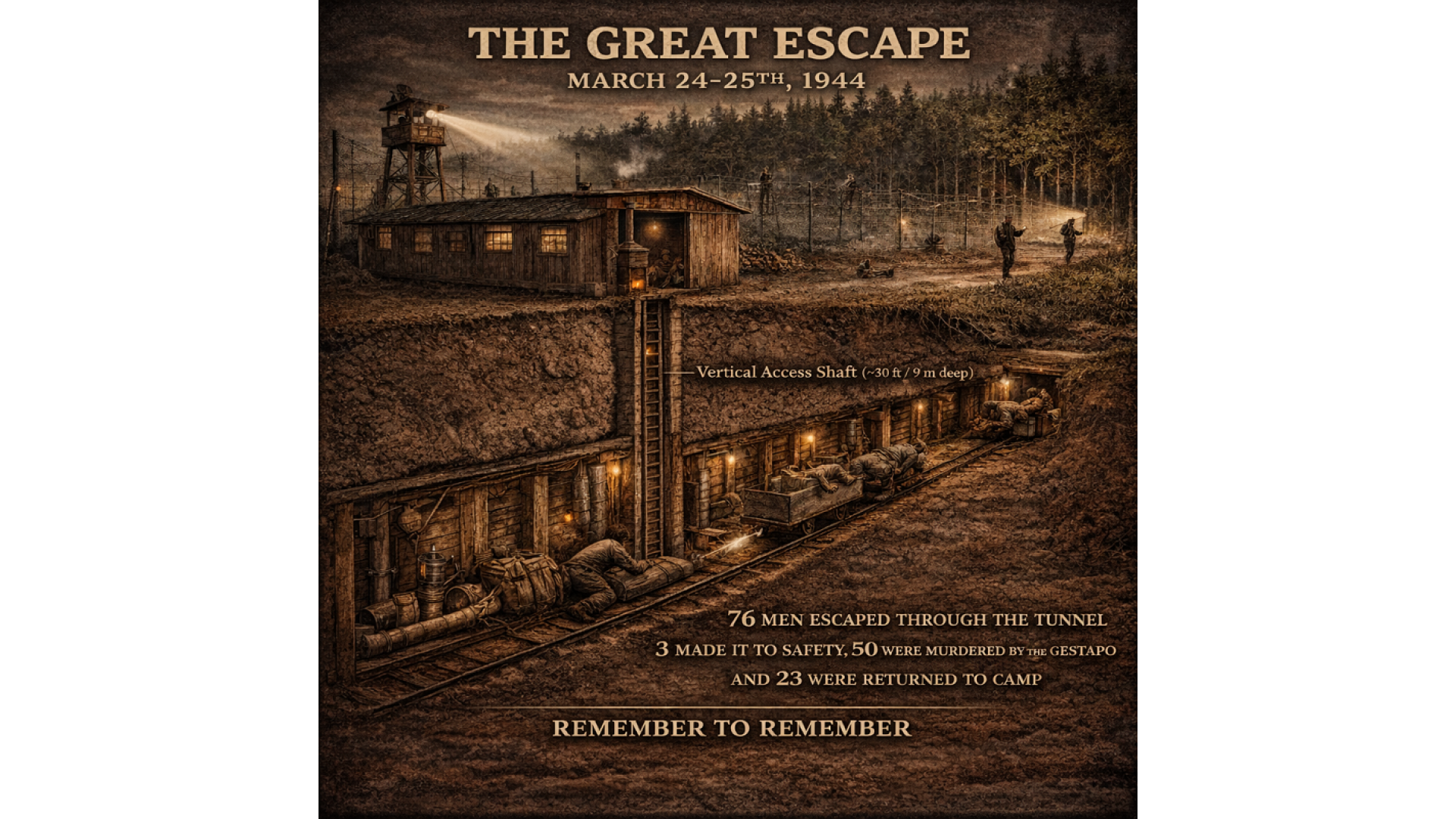
On the cold night of March 24–25, 1944, inside the
German POW camp Stalag Luft III, 76 Allied airmen crawled into a narrow
tunnel known only by one name: Harry.
The plan had been conceived by Roger Bushell, known
among the prisoners as “Big X.” His vision was not simply to free a handful of
men, but to unleash 200 escapees across Europe to disrupt the German war
machine and force thousands of soldiers into the hunt.
For months the prisoners secretly built three tunnels: Tom,
Dick and Harry, more than 30 feet underground to avoid German
seismic microphones. The engineering behind the effort was nothing short of
astonishing.
The ground beneath Stalag Luft III played a critical role in
both the challenge and success of the escape. The camp sat on deep, loose, yellow
sandy soil that was easy to dig but dangerously unstable, forcing prisoners
to reinforce the tunnel with hundreds of wooden bed boards to prevent collapse.
The sand’s bright colour also created a major problem, every
handful of sand had to disappear and there were more than 200,000 pounds of it. It stood out sharply against the darker
surface soil, which lead to ingenious methods of disposal like the use of
“penguins” the nickname given to POWs who secretly scattered sand around the
camp by prisoners using modified trousers with hidden pouches sewn inside. As they walked around the camp, they
would release sand slowly through small holes, letting it trickle out
and shuffled their feet to make it disappear into the ground making them look
like penguins, which is where the name came from.
Now a Canadian pilot named Wally Floody, a former
gold miner from Ontario, designed the tunnels. Using his mining expertise, he
helped create ventilation systems, rail carts and structural supports out of
stolen scraps.
More than 1,400 powdered milk tins labelled “Klim”
were turned into a ventilation system. Knives, forks and spoons became digging
tools. Bed boards became railway tracks. Gramophone parts became trolley
wheels.
One key figure was Albert P. Clark, who served as the
escape organization’s head of security (“Big S”). His job was to ensure
the secret operation remained hidden from German guards. Another was David
M. Jones, who helped lead one of the digging teams working on Tunnel Harry.
American prisoners also helped with the massive task of hiding
excavated sand, organizing supplies and supporting the escape committee. But
months before the tunnel was completed, the Germans transferred American
prisoners to the South Compound in September 1943 and because of that move,
none of them were present in the compound when the escape actually occurred.
This is why no Americans were among the 76 men who
escaped that night.
There was one unusual exception often mentioned in records: Johnnie
Dodge. Dodge was American-born but had become a naturalized British
citizen serving in the British Army, so he was counted among the British
officers.
Shortly after 10 p.m., the first man crawled into the narrow
tunnel.
One by one, through darkness and freezing ground, 76 men
reached the forest outside the wire before a German guard discovered the
exit.
Only three men ultimately
made it to freedom: Bram van der Stok (Netherlands) reached
Gibraltar, Per Bergsland (Norway) escaped to Sweden along with fellow
countryman Jens Müller. The remaining 73 were recaptured and then
the story took a darker turn. 23 made it
back to camp, but on direct orders from Adolf Hitler, the Gestapo
executed 50 of the recaptured officers in cold blood a clear violation
of the Geneva Convention. Their ashes were returned to the camp as a warning. This
is not just a statistic it’s the reality behind the story. The Germans thought
it would demoralize the prisoners but instead, the murders strengthened Allied
resolve.
After the war, a small RAF investigation team led by Frank
McKenna and Wilfred Bowes tracked the killers across a devastated
Germany. Their investigation uncovered meticulous crematorium records proving
the executions.
The results: Of the 72 Gestapo personnel identified, 21
were executed, 17 were imprisoned and 11 committed suicide before trial
It became one of the most determined war-crimes investigations in Allied history.